
Cynical Theory Benefits
Cynical Theory is a framework that provides simple rules to analyze and comprehend complex motivation and behavior to improve your life.
Using Cynical Theory
Is Cynical Theory going to change your life?
Maybe.... ....but probably not.
If you are looking for a silver bullet to change your life, Cynical Theory isn't the answer.
If you expect that there is "something" out there that will improve your life, fix your problems, or deliver success, you will be disappointed.
If you expect that you can use Cynical Theory to manipulate and exploit others, you are treating the symptom, not addressing the problem.
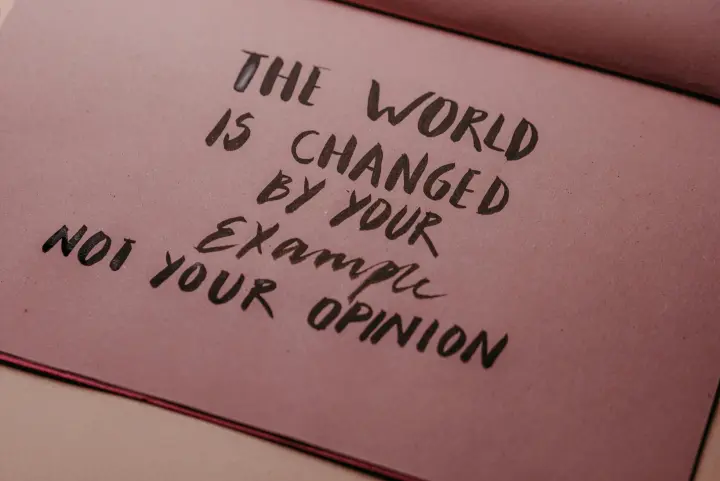
If you want to improve your situation, you must proactively improve yourself. You will not succeed if you think more money, more work, more luck, or better circumstances are the answer to your prayers. Changing external factors may work in the short term, but sustainable improvement only appears when you change yourself.
The hardest thing you will ever do in your life is to change yourself.
- Gary Bozek (1985)
Cynical Theory guides data gathering to help you understand YOURSELF or OTHERS better. To improve YOUR life, you must work on YOURSELF first!
When you understand yourself, you can analyze and decide what to improve to reach your goals. Cynical Theory can provide the insight to understand what's going on in your head so you can gain control of your motivation and behavior.
Let's explore how you can use Cynical Theory to improve your life.
Understand Yourself
You can use the Cynical Theory Axioms to analyze your motivation and behavior.
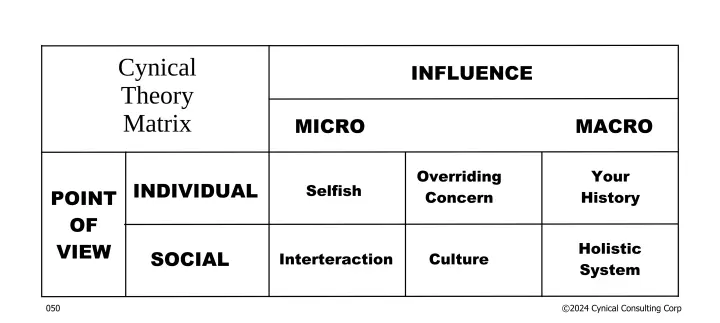
By understanding yourself better, you make logical, reasoned decisions that positively affect your outcomes.
1. Selfish
Do you understand your selfishness?
If you analyze a personal or business situation, are you acting selfishly?
If your philosophy is that the pie is only so large, and you want the biggest piece, are you winning the battle but ultimately losing the war? People often let short-term thinking sabotage their ultimate long-term success.
I suggest you selfishly look at what your long-term goals are to focus on and work toward them. Don't let a short-term selfish act undermine or jeopardize your long-term success.
I worked with a person who would take credit for other people's achievements. He was successful in getting management's attention and receiving a promotion. After his promotion, his subordinates didn't trust him and wouldn't perform to the best of their ability. They were onto his game and undermined his performance. He barely lasted a year in the position before being forced to leave the company. (Short-term focus pooched his long-term goal!!!)
Unrestrained selfishness is one of the primary factors that undermines results.
I advocate practicing compassionate, ethical, altruistic, and constructive selfishness.
2. Overriding Concern
Ideally, being selfish should result in picking the best course of action for yourself.
As discussed above, the trap is letting the wrong justification take precedence. A short-term action may undermine a long-term goal.
Being conscious of the ramifications should lead you to override a short-term focus and recognize that you are better off in the long term.
Another factor you should consider is if your selfishness is causing you long-term harm. Habits, beliefs, wants, needs, or laziness are classic factors that can undermine your decisions and negatively impact your results.
Another issue to consider is if you are NOT making a selfish decision. Is there something that benefits you that you are not doing? Have you let an overriding concern interfere with making the right decision for yourself? Don't let habits, beliefs, wants, needs, or laziness undermine your decisions and negatively impact your results.
I had a friend who smoked. He didn't know why he started smoking or why he continued. There was nothing I could say or do to help him stop. Like the joke, he would tell me, "Quitting is easy, I've done it many times."
It wasn't until he acknowledged to himself that he was smoking to keep his hands busy. With that recognition, he substituted other activities in its place and kicked the habit for good.
Understanding the factors that influence our bad decisions or our unwillingness to make good decisions, can free us to pursue a path that benefits us.
3. Your History
Have you ever contemplated the significant events that occurred in your life and how they have affected you?
Do aspects of your personality contribute to behavior that does not benefit you? Are you aware of the trauma at the origin of a particular personality characteristic?
If you want to make changes in your life, you need to recognize, acknowledge, and overcome the trauma.
I grew up in a broken family; I didn't have good role models or examples of healthy relationships. As a result, I developed trust issues. It affected how I entered and participated in friendship or romantic relationships.
Although I was aware of my shortcomings on an intellectual level, it took a failed marriage and several decades before I was able to deal with it emotionally and make changes.
We become who we are today from the passage of time. All the good and bad events make an impression on our personalities and become baggage we carry.
If you want to unburden yourself and change for the better, you must confront the aspects of your history holding you back from success.
4. Interaction
Have you ever noticed you expose a different personality when interacting with others?
It is easy to recognize when you are in different roles. That is, you are different at work than at home or with friends.
However, if you dig deeper, different coworkers will bring out diverse aspects of your personality. You may be fully engaged, open, and cooperative with one peer, but distrustful, standoffish, and guarded with another.
They each have different personalities; your interaction with them triggers different aspects of your personality.
Once you recognize the nature of positive or negative character traits that influence your behavior, you can proactively improve your interactions.
You can't change them - the only person you control is yourself - so change has to come from you. If you want different results in your interactions with a specific person, you must proactively choose to behave differently.
I didn't have a good relationship with my father. I resented what he had done to our family and avoided spending time with him. When my son was born, I decided that, despite my personal opinion, I should not deny my son the opportunity to know him.
I changed my viewpoint and chose to accept him for who he was. My son saw a different man (as did I) from who he was when I was young.
Once you realize you have the power to choose how you act, you can take more control of your decisions to achieve the result you want.
5. Culture
Culture refers to a wide range of factors that influence our behavior.
I propose a simplified definition: culture refers to the programming you agree to abide by.
My preferred descriptor is BRAINWASHING.
You have been brainwashed to believe that your viewpoint IS your truth. This programming exists on all levels of our intellectual, physical, emotional, and spiritual lives.
You choose to behave by the rules you accept.
A civilized society requires this; we need to behave per the rules of society, otherwise we have chaos and anarchy.
However, a stalwart adherence to ALL your brainwashing isn't necessarily good for yourself or society. For example, full compliance would mean nothing ever changes. In that environment, there would never be any improvement.
You need to be aware of the bias, prejudice, and stagnation that can occur by absolute, unquestionable compliance.

In Canada, the Rhino Party challenged the status quo by proposing adopting the British driving system (on the left side of the road). They suggested a phased approach with large trucks and tractors adopting it first.
It is unhealthy to relinquish your power to decide what is best for yourself. You must be aware of your choices by evaluating the alternatives. Like the Rhino example above, you may determine it is a horrible choice to change.
The key is to proactively understand, evaluate, and make a conscious, rational, and reasoned decision about the influence you accept.
6. Holistic
We participate in a big, interconnected, and interdependent system.
Our actions affect the system, either positively or negatively, whether we are aware of them or not.
Our actions affect others, either on a micro or macro level, whether we intend to or not.
Our actions affect ourselves, either on a micro or macro level, whether we anticipate the consequences or not.
The environment and global warming are examples of how each individual's actions accumulate to affect the world. We all have the power to make choices today, which may seem insignificant at the micro level; if applied by a large population, on the macro level, it will have a positive or negative cumulative effect on the environment.
Many people don't consider the system that exists beyond their proximity. If they can't see or touch it, it doesn't exist. Therefore, they don't recognize the opportunity to capture future rewards through their actions today.
Another parallel is many people get blindsided by decisions made by those in power or leadership positions. Their lack of awareness means they don't see the consequences coming - even if the signs were there - and suffer immensely because of unpreparedness.
Your everyday, mundane decisions and actions invariably affect the system near you and will have ripple effects out to the system at large.
You need to be aware of and take responsibility for the consequences of your decisions, even if the effects are long-term or affect others.
Understand Others
If you study psychology, or have an intuitive understanding of how people think and why they act the way they do, the above won't be a big revelation.
If you never considered how much your performance and results are proportional to how you interact with others, I hope I've enlightened you.
If you want to gain more control over your life, performance, and results, Cynical Theory provides an analytic framework to guide your examination of what works for you and what doesn't.
Cynical Theory is not a prescriptive framework -- it doesn't provide step-by-step instructions to accomplish something.
It is a far more powerful tool. It is a framework to focus your inquiry, analysis, decisions, and actions to help you improve your life.
What part of your life?
That is entirely up to you.
The Cynical Guru website discusses and demonstrates how to use Cynical Theory and other associated tools, techniques, and processes to accomplish your goals. I am still creating the content; see the Roadmap or Status Page.
I realize you are anxious to get started and apply Cynical Theory in your life, so I suggest the following approach:
1. Practice On Yourself
Understand yourself first!
You cannot practice on others first.
First, you wouldn't have developed the judgement to discern false positives or negatives from your analysis. Use the framework to analyze yourself. You know the answers to the questions posed; you know if you're lying to yourself; you know where your pain points are; you know what you want to improve. If you can't face yourself, you won't have the capacity to understand others.
Second, the primary benefit of Cynical Theory is when you leverage your understanding of yourself. It is easy to believe all your problems are external and caused by others, but the reality is that you make your problems. Cynical Theory encourages you to take responsibility for who you are today and can guide you to be a better person tomorrow.
Third, you will recognize that you are a complex being. You possess unique biases, prejudices, and predispositions that you may or may not be aware of; your ability to recognize and assess them is paramount to successfully implementing changes (or accepting the characteristic).
Before you start, there are some prerequisites:
- Curiosity - you need to prepare to delve into areas of your personality that you ignore
- Confidence - you need to ask yourself the tough questions
- Honesty - you have to answer yourself honestly
- Accepting - you shouldn't judge yourself and beat yourself up; recognize things for the way they are
- Patience - Rome wasn't built in a day; it is a journey you are embarking on
You can start with the questions and avenues of inquiry discussed above in each axiom. Use them as a guide and extrapolate the questions or areas of your life, experiences, personality, or biases to explore. You can start with the first axiom and explore it fully. Then proceed to the next axiom. You may find that what you uncover may require a return to a previous axiom to explore further. That is normal - it is like archaeology - keep digging and try to understand what you uncover.
There are no right or wrong answers - only your answers.
When you deeply understand yourself, you should start to discern patterns in thinking and the influences that shaped your personality. With that knowledge, you are ready to assess others.
2. Practice On Others
Cynical Theory is a tool; like all tools, you can apply it to do good or evil.
If you intend to use Cynical Theory to manipulate or exploit others, I strongly discourage that. Selfish behavior has short-term rewards, but long term, you will undermine your success. (It demonstrates you don't understand Axiom 6 and that throwing sand into the gears will damage the system around you.)
Unless you read minds, you won't know what other people think.
You may think you have a superior intellect and can discern people's motivation from their behavior. You may be right. But it is likely a trap – your own biases and points of view influence your conclusions.
You can't trust your conclusions unless you have trained yourself to practice the scientific method.
When applying Cynical Theory to others, the first goal is to gather data. The more data you have, the better your analysis will be. You need to gather data from the other person, not jump to conclusions based on assumptions.
The only way to gather data is to ask.
The questions you ask, how you ask them, and how you react to the answers all affect the quality of the data you gather. The data quality affects the quality of the analysis and conclusions you arrive at (GIGO).
When you apply and practice specific techniques, you can improve your ability to gather data from people.

3. Level UP
I believe in the scientific method.
You should think about the first two steps and determine if Cynical Theory makes sense and can help you.
You should determine if Cynical Theory can help you:
- have a better understanding of yourself
- have a better understanding of others
- leverage the understanding and skills to improve your life
If you want to use Cynical Theory to improve your life, I suggest you learn more by Leveling UP.
Learn to use the Cynical Theory framework, Science, Logic, and Common Sense to conquer the Cynical World by Leveling UP to Level 1.
Summary
Cynical Theory guides data gathering to help you understand YOURSELF or OTHERS better.
When you understand yourself, you can see where you are sabotaging yourself and implement improvements in your life.
When you understand others better, you master how to work WITH them to reach mutually agreeable goals.